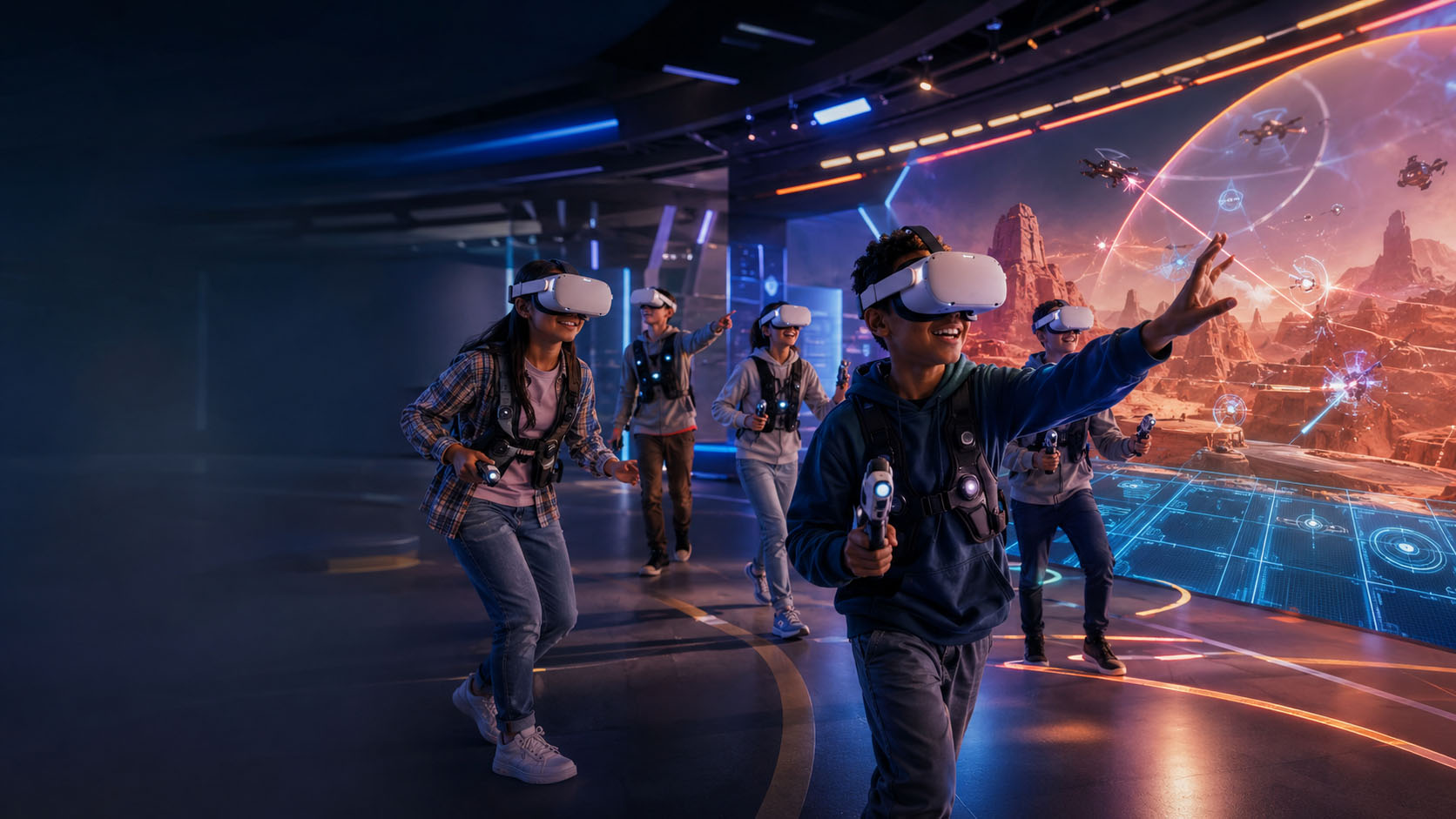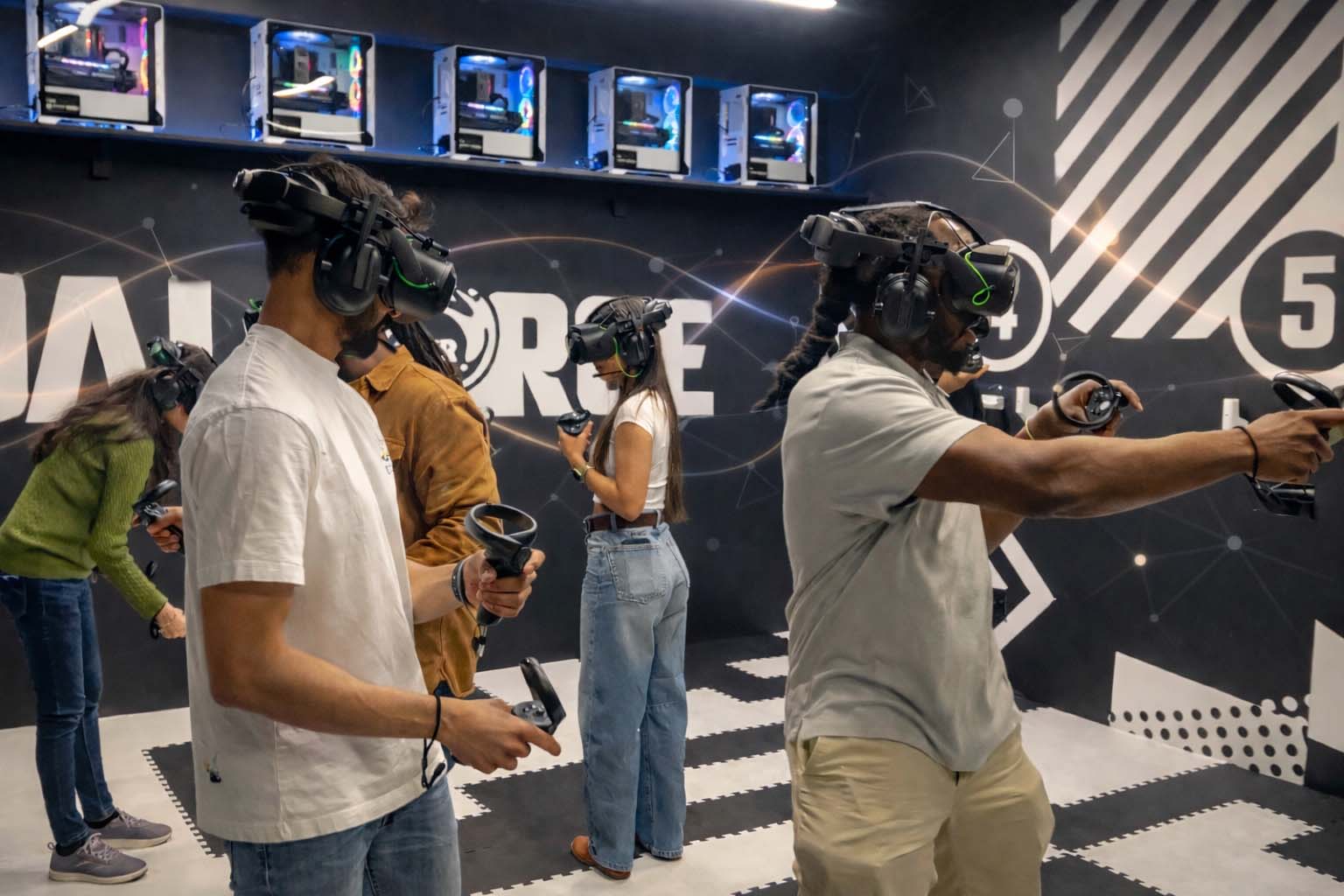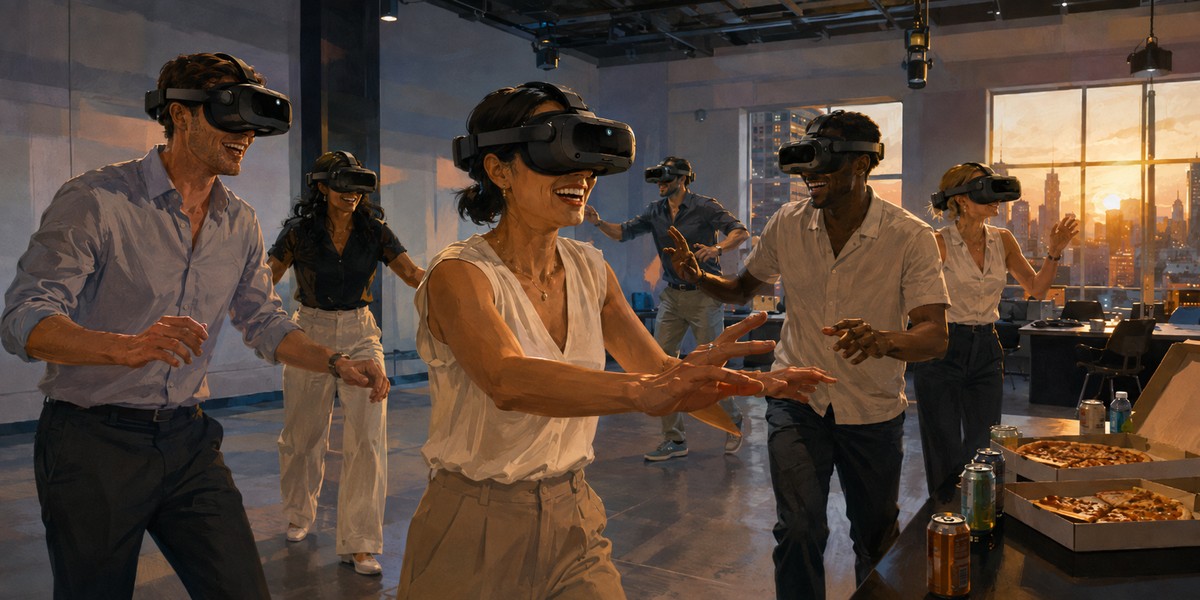
A phrase I often steal from my Gen Alpha child is “lock in.” They have more phrases and colloquialisms than I can fathom, but locking in is my absolute favorite. For those not hip or in the know: to lock in is to commit fully to completing a task, or to work in sync with others until it's done. Gen Xers might call it being in the zone. Neuroscientists today might call it a derivative of flow state, the optimal condition for human performance. You see it when jazz bands play together, or oil rig workers mid-drill. We also see it when groups play our VR experiences.
Take Tidal Force. Players wake suddenly from cryosleep aboard a ship traveling through space, greeted by alerts of critical system failures and imminent catastrophe. Somewhere in the darkened vessel is a way home, if they can restore its systems before time runs out.
The first step to success, without spoiling the experience: wake the teammates locked in the crew cabin with you, and attempt an escape.
From there, players rely on their team by dividing the problem, because there is too much happening for everyone to focus on the same thing. They share discoveries, test ideas, correct one another, and adjust their approach. These are the same behaviors a cross-functional meeting is supposed to encourage, except nobody has to ask them to collaborate. The stakes are different. In the meeting, they're real: a team that can't lock in on the deliverable costs the company. The mission is where those same behaviors get to show up for free.
The ship may be fictional, but the situation has real implications. Teams that succeed in Tidal Force learn to rely on each other quickly to save themselves and complete the mission. They leave with a stronger bond than the one they came in with. None of that is an accident. It comes from careful design and experience crafting, and the power of multiplayer immersive virtual reality.
Say “VR” and most people picture someone at a mall kiosk, headset on, waving at things nobody else can see. A single-player gimmick for ten-year-old gamers. A roller coaster that makes you dizzy, or a multibillion-dollar pivot by a social media company. We don't see VR like that, and we don't build those kinds of experiences. We believe VR is a tool that can bring people together in situations and environments they otherwise would never get to share. It is social in a way the other “social” technology isn't, with its users stuck behind a keyboard and mouse, or doomscrolling between liking old high school friends' wedding announcements.
So instead we built a 3,300-square-foot facility where players roam freely with their group through immersive, out-of-this-world environments, engineered for functionality, comfort, cooperation, and fun. Enjoyment is baseline. But fun was never the only design goal. We build authored worlds with pacing, pressure, and problems shaped so a group can lock in and operate as a crew; the same group flow you'd find in a jazz band in Harlem, or the union electricians wiring up NYC's next skyscraper.
Our working theory, from watching hundreds of groups: a team outing succeeds or fails on whether it produces a moment where coworkers genuinely rely on each other. The research points the same way. Arthur Aron's work found that novel, activating experiences build more closeness than pleasant, familiar ones. But you cannot schedule that moment. You can only build a situation where it becomes likely. That is the actual job description of a mission designer.
Flow isn't mystical. Psychologist Mihály Csíkszentmihályi named it in the 1970s, and researchers have been mapping it ever since: a clear goal, immediate feedback, and a challenge matched to your skills. It has to be hard enough to demand your full attention, but not so hard that you quit. Miss one and people drift into boredom or anxiety. Hit all three and attention narrows, self-consciousness drops, and time gets strange. When we design a mission, those three conditions are the spec. The objective is unmistakable, the world reacts instantly to everything you do, and the pressure ramps to the edge of the group's ability, because that edge is where locking in happens.
Flow was first studied in individuals: the solo climber, the pianist. Team flow is the shared version, experienced while people perform interdependent tasks in service of the team. Researchers developed and tested a Team Flow Monitor across 110 teams. Team flow was positively related to team performance, positivity, and happiness. In a separate series of experiments, psychologist Charles Walker found that shared flow was more joyful than solitary flow. The more teammates had to depend on one another, the stronger the effect. Needing each other isn't the awkward part of a team activity you design around. It's the part that makes it work.
Bodies get in on it too. Oxford researchers found rowers who completed the same workload in synchrony showed a stronger endorphin response than rowers who did it alone. A 2023 study recorded the facial expressions and physiological arousal of 86 previously unacquainted adults as they watched a show together. The more their positive expressions and physiological responses synchronized, the more connected they reported feeling afterward. We see the everyday version of that weekly: the half of a big group waiting for their rotation isn't really waiting. They're calling out, wincing, cheering, locked into an attempt that isn't even theirs.
VR makes those fictional stakes feel present. You know the world isn't real, and your body behaves as if it were. Walk people to the edge of a virtual pit and their heart rate and skin conductance climb as if the drop were real. Presence does not create team flow by itself. It makes fictional stakes feel immediate enough to hold a group's attention while those team dynamics emerge. When the alarms start, nobody is half in the room and half on their phone.
Forty-five minutes may be enough. A randomized trial found that 45 minutes of cooperative play improved how newly formed teams performed on the task that came after. The teams performed better, but the study did not find increased cohesion. A study of 62 hospital teams, one 45-minute escape-room challenge produced cohesion gains still measurable a month later; only half the teams escaped. The attempt mattered more than the win.
The outing also has to be voluntary. A Wharton study of several hundred salespeople found that employees who opted into a gamified activity responded positively, while unwilling participants came away with worse attitudes and weaker performance. That is more than a legal nicety. Choice is part of the design. Frame the outing as an invitation, not a mandate.
The target is not hardship. It is a shared challenge, freely entered, with real feelings and no real consequences.
No peer-reviewed trial has measured free-roam VR as a corporate team-building intervention. The evidence is a chain: cooperative play works, short shared challenges work, and VR intensifies the presence and novelty they run on. We think the chain holds, but it is still a chain.
Viral asks more of a crew than anything else we run. An outbreak has put humanity at risk. The answer is a biosample somewhere inside a maximum-security prison. Your team is the one going in. Without spoiling what happens in there: the group has to stay together, call out what they see, cover one another, and keep their heads while the mission does its best to overwhelm them. Clear goal, instant feedback, pressure right at the edge. Forty minutes of locking in.
// FROM THE FLOOR
One of the sessions we remember best was a group of HR executives. One person told us she had never picked up a controller. An hour later she was deep in that prison with the youngest members of her team, working the same problem on equal terms, with composure counting for more than seniority. Their titles hadn't disappeared outside the room. Inside it, the titles simply weren't useful.
Afterward, the lobby did what the lobby always does: the retelling. Who froze, who made the call, who saved whom. The team waiting to go in has been watching the screens, calling out, wincing, and cheering. By the time the headsets come off, both groups already know the story. We hear it again in their reviews, and sometimes a year later, when the team books another outing. That story walks back into the office on Monday. That's the bond.
You cannot schedule the moment your team locks in. You can choose the environment that makes it likely: a clear goal, real interdependence, pressure at the edge of the group's ability, and a crew that chose to be there. Keep those things in mind wherever you book the outing. If it's with us, we'll build the mission around your crew.